
Markets that never close do more than extend the trading day. They remove the operational boundary around which monitoring, reconciliation, maintenance and human intervention were traditionally organized.
That change has a practical consequence: continuous participation cannot depend on continuous human attention. It depends on systems that remain observable, bounded and interruptible when attention is elsewhere. Automation must handle routine conditions, but it must also recognize when conditions fall outside its authority and move toward restriction rather than uncontrolled continuation.
For market participants, operational readiness is therefore not another name for permanent staffing. It is a property of the operating model.
The Market Close Created Space for Operations
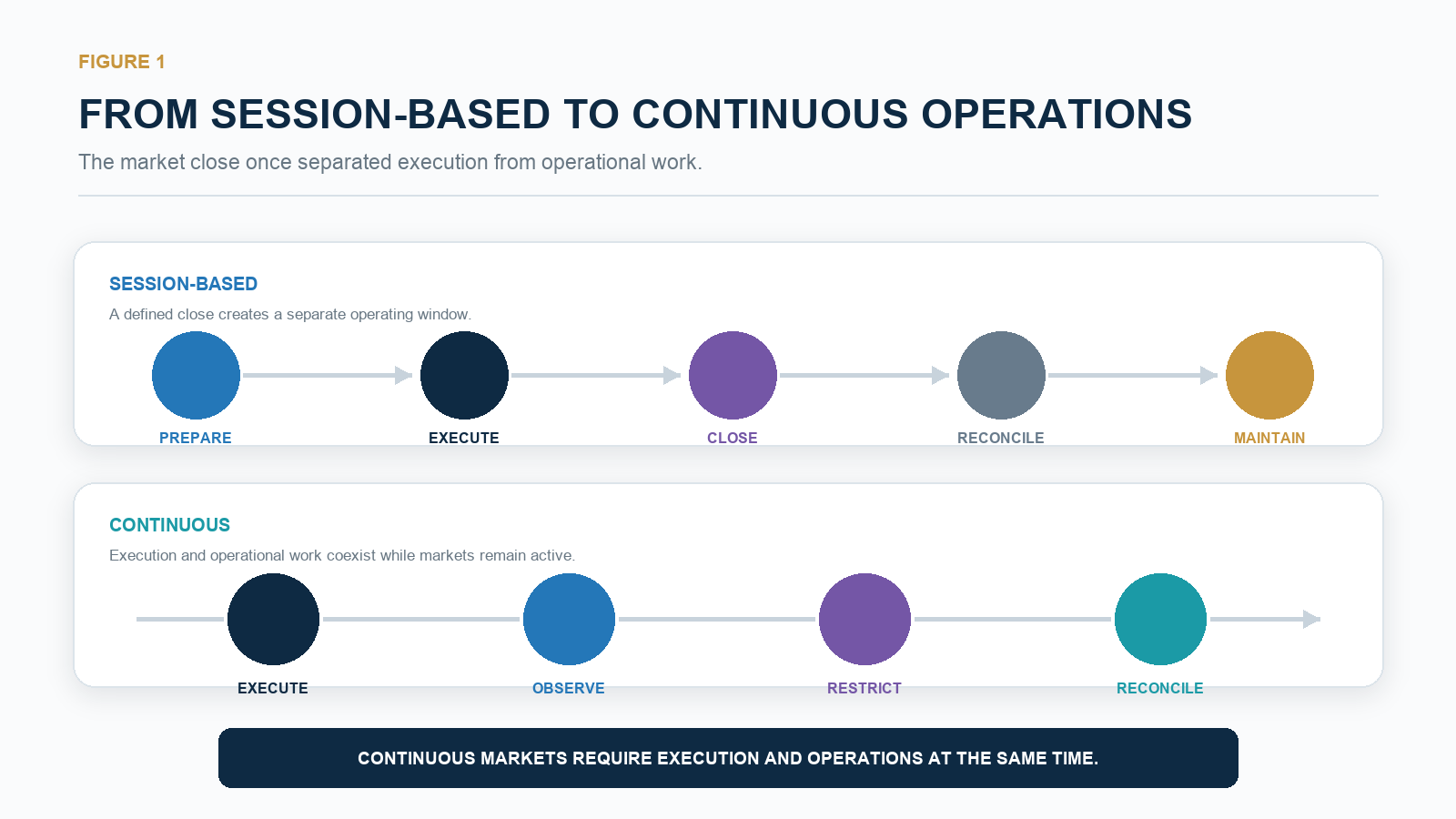
Traditional markets were organized around a recognizable sequence. Teams prepared for the open, supervised a trading session and used the close to reconcile activity, review exceptions, perform maintenance and prepare for the next day.
The close did not remove every risk, but it created a period in which the operating environment became quieter and more stable. Many familiar processes were designed around that space: end-of-day controls, batch reconciliation, overnight reporting and scheduled system changes.
Continuously connected digital markets do not provide a universal equivalent. One region slows as another becomes active. Liquidity moves between venues. Market conditions can change while systems are being updated or an exception is being investigated.
The market close once separated execution from preparation. Continuous markets require both to happen at the same time.
Continuous Availability Extends Exposure
Continuous trading is often presented as greater availability. Operationally, it is also an extension of exposure.
Orders can remain active while liquidity changes. A delayed data feed can affect decisions while execution continues. A venue connection may appear available even though acknowledgements are incomplete. Small reconciliation differences can accumulate before they become obvious.
This is why uptime is not enough. A service can be online and still behave in a way that is delayed, inconsistent or difficult to interpret. Market participants need to know not only whether a system is running, but what state it is in and whether its behaviour remains within expected boundaries.
Availability answers one question: is the system running? Observability answers the more useful question: do we understand what it is doing?
Automation Needs an Operating Perimeter
No team can manually supervise every market event, message and order across a continuously connected environment. Automation is necessary, but maximum autonomy is not the objective.
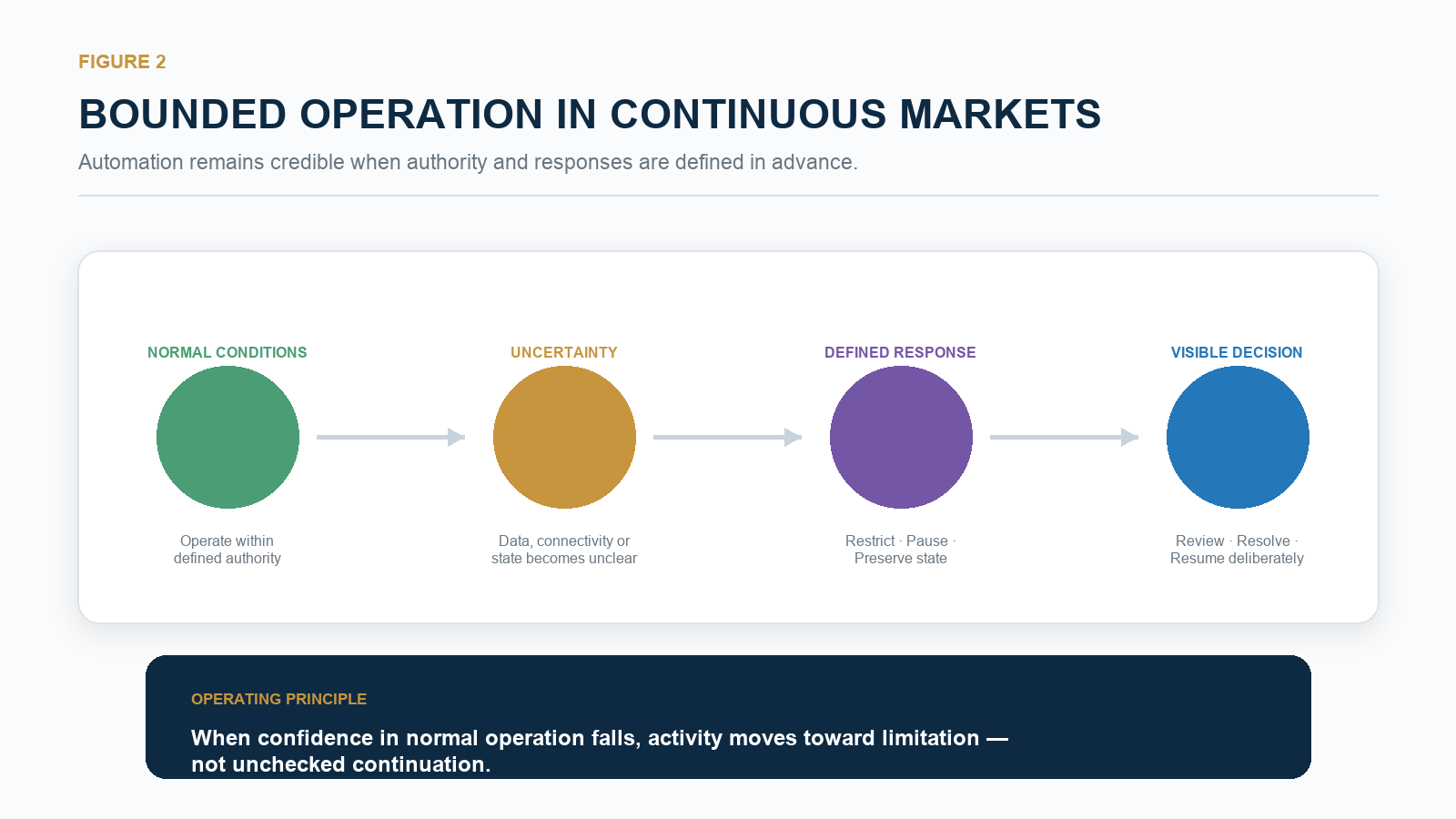
The relevant question is authority. What may the system do under normal conditions? What limits apply? Which conditions require restriction, escalation or interruption? Those decisions should be made before an exceptional event, not improvised during one.
A well-defined operating perimeter gives automation room to perform routine functions while limiting what can happen when conditions become unclear. If data quality deteriorates, connectivity becomes uncertain or system state cannot be established, the appropriate response may be to restrict new activity, pause an affected function or preserve state for review.
This does not eliminate incidents. It reduces the chance that a local problem becomes a larger one simply because automation continued without a reliable understanding of its environment.
Continuous Coverage Is Not Continuous Staffing
Continuous markets do not imply that someone must watch every process at every moment. The more important question is what happens when nobody is actively watching.
An unattended system should not have unlimited freedom to continue. Its authority should remain bounded, its state should remain visible and its response to uncertainty should be defined. Human judgment is then reserved for decisions that genuinely require it: changing authority, resolving an exception or deciding when normal activity can resume.
Visibility also matters to the client. In a non-custodial operating model, the client retains ownership and control of assets held in client-controlled accounts. Operational information can be surfaced without transferring custody or suggesting that transparency is the same as guaranteed intervention.
Readiness is therefore a system property, not a promise that somebody is permanently waiting. It means that unattended operation remains within a controlled perimeter and can move toward limitation when confidence in normal operation is reduced.
The CatsQuant Perspective
CatsQuant develops non-custodial systems and infrastructure that enable qualified market participants to deploy systematic strategies through their own accounts while retaining control of assets, accounts and operational decisions.
Within the authorized operating framework, CatsQuant infrastructure supports systematic execution and operational visibility. The purpose is not to promise uninterrupted markets, eliminate risk or replace client responsibility. It is to provide a clearer and more controlled way to participate in markets that continue operating beyond traditional trading hours.
This distinction matters. Continuous markets need automation, but automation is credible only when its authority is defined, its behaviour can be observed and activity can be limited when conditions no longer support normal operation.
Conclusion
Continuous markets remove the pause that once separated trading from operational work. The answer is not permanent human supervision, nor automation without limits.
It is an operating model designed for activity that continues: observable under normal conditions, bounded when unattended and capable of moving toward restriction when uncertainty increases.
Continuous markets require continuous operating models.