
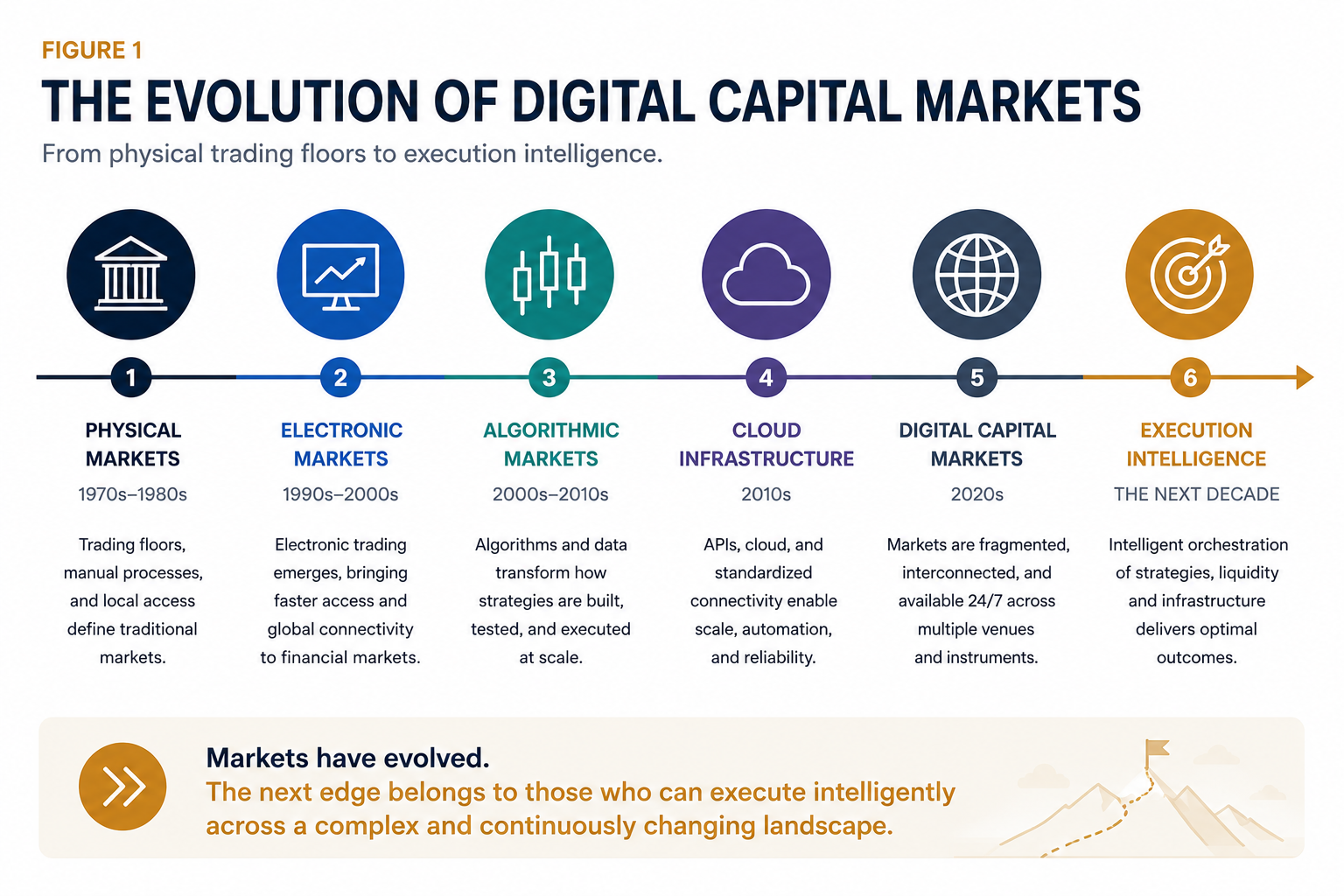
Capital markets are undergoing one of their most significant structural transformations since the transition from physical trading floors to electronic markets. As markets become increasingly digital, continuously connected, and software-defined, access has become more widely available while operational complexity has grown substantially.
Execution is no longer limited to placing orders. It encompasses infrastructure, connectivity, orchestration, automation, risk management, and operational resilience. These capabilities increasingly determine how efficiently organizations can participate, scale, and adapt within modern digital capital markets.
This Insight explores why execution is evolving from an operational function into a strategic capability, how market infrastructure is becoming a source of competitive advantage, and why intelligent operating models will increasingly define the next generation of digital capital markets.
The Digitalization of Capital Markets
For decades, financial innovation focused primarily on products.
New exchanges.
New asset classes.
New derivatives.
New investment vehicles.
New regulations.
Yet beneath every financial innovation lies something considerably more fundamental: infrastructure.
Markets exist because infrastructure exists.
Matching engines, market data networks, communication protocols, clearing systems, settlement mechanisms, custody solutions and execution technologies collectively determine how efficiently capital moves through the global financial system.
Historically, much of this infrastructure remained invisible. Institutional participants developed proprietary connectivity, banks built internal execution capabilities, and trading firms invested heavily in technology that rarely extended beyond their own organizations.
Today, that landscape is changing.
Capital markets are becoming increasingly digital, software-defined and continuously connected. Electronic trading, cloud computing, standardized connectivity, APIs, automation and programmable financial systems have fundamentally changed how market participants interact with markets.
Digital asset markets did not create this transformation. They accelerated it.
What was once considered innovation is rapidly becoming the new operational baseline.
Infrastructure has become strategic.
Execution has become more than the final step of a trade.
Execution is becoming an operating capability.
From Access to Execution
Historically, gaining access to financial markets represented a significant competitive advantage.
Participation often depended on exchange memberships, proprietary networks, dedicated infrastructure and privileged relationships with brokers or liquidity providers. Connectivity itself created differentiation because relatively few organizations possessed the technical and operational capabilities required to participate efficiently.
That environment has changed dramatically.
Today, standardized APIs, FIX connectivity, cloud infrastructure and mature software ecosystems have made market access substantially more accessible than at any previous point in financial history. Connecting to an exchange is no longer the primary challenge.
Operating efficiently across an increasingly complex market landscape is.
Competitive advantage is therefore shifting away from simple connectivity toward execution quality.
Execution is no longer measured solely by whether an order reaches a marketplace.
It increasingly depends on how intelligently infrastructure coordinates routing, manages operational complexity, adapts to changing market conditions and maintains resilience across continuously operating systems.
Access has become increasingly commoditized.
Execution has not.
Continuous Markets Change Everything
One of the defining characteristics of modern digital capital markets is continuity.
Traditional financial markets operated within clearly defined trading sessions. Infrastructure could be started each morning, monitored throughout the trading day and gradually wound down after the market closed.
Continuous markets fundamentally alter these assumptions.
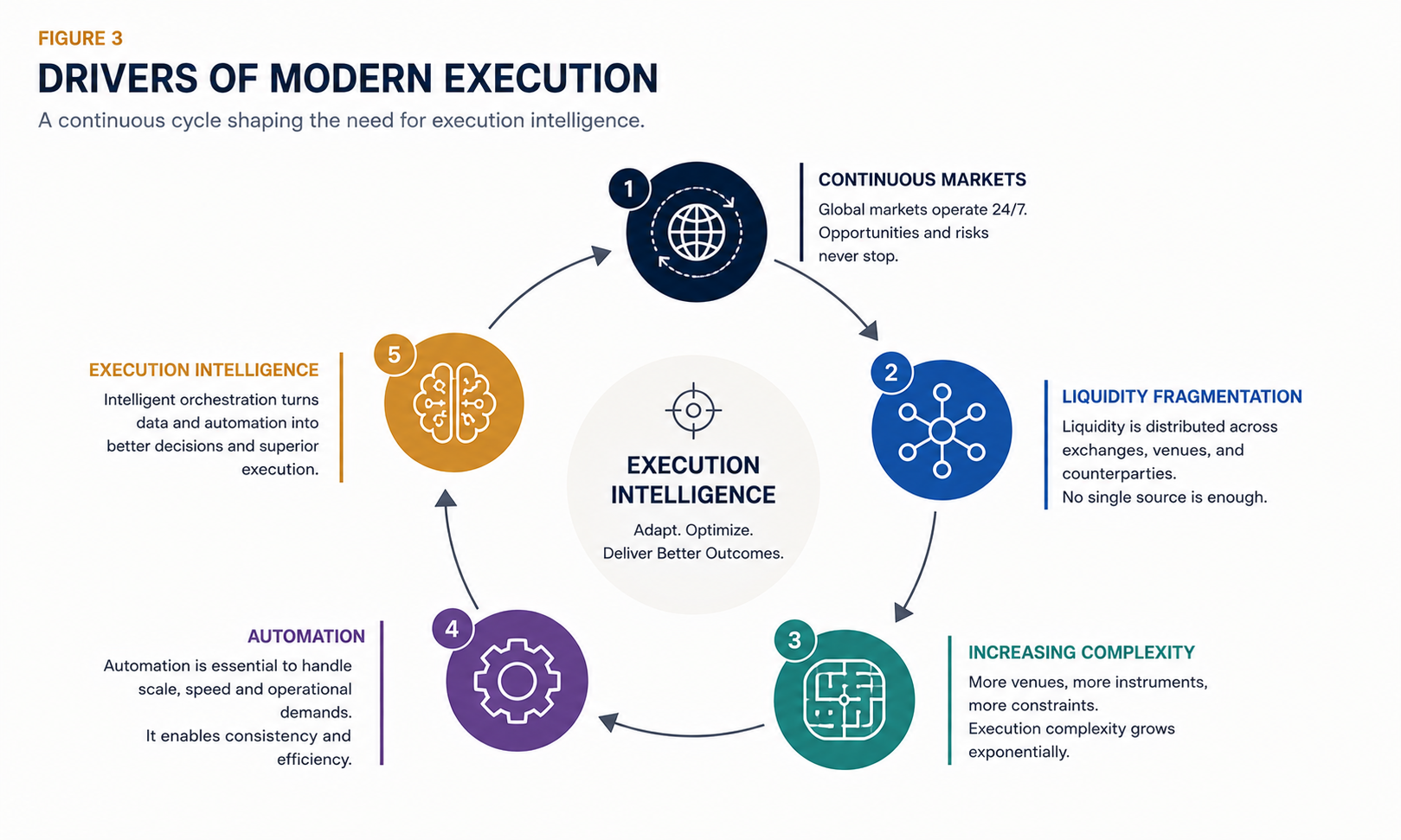
Trading increasingly occurs twenty-four hours a day, seven days a week, across globally distributed venues serving participants operating in different jurisdictions and time zones.
As a consequence, infrastructure itself must become continuous.
Monitoring becomes continuous.
Connectivity becomes continuous.
Risk management becomes continuous.
Operational resilience becomes continuous.
The challenge is no longer extending market hours.
It is designing systems capable of operating reliably without interruption.
Continuous markets require continuous operating models.
Liquidity Is No Longer Centralized
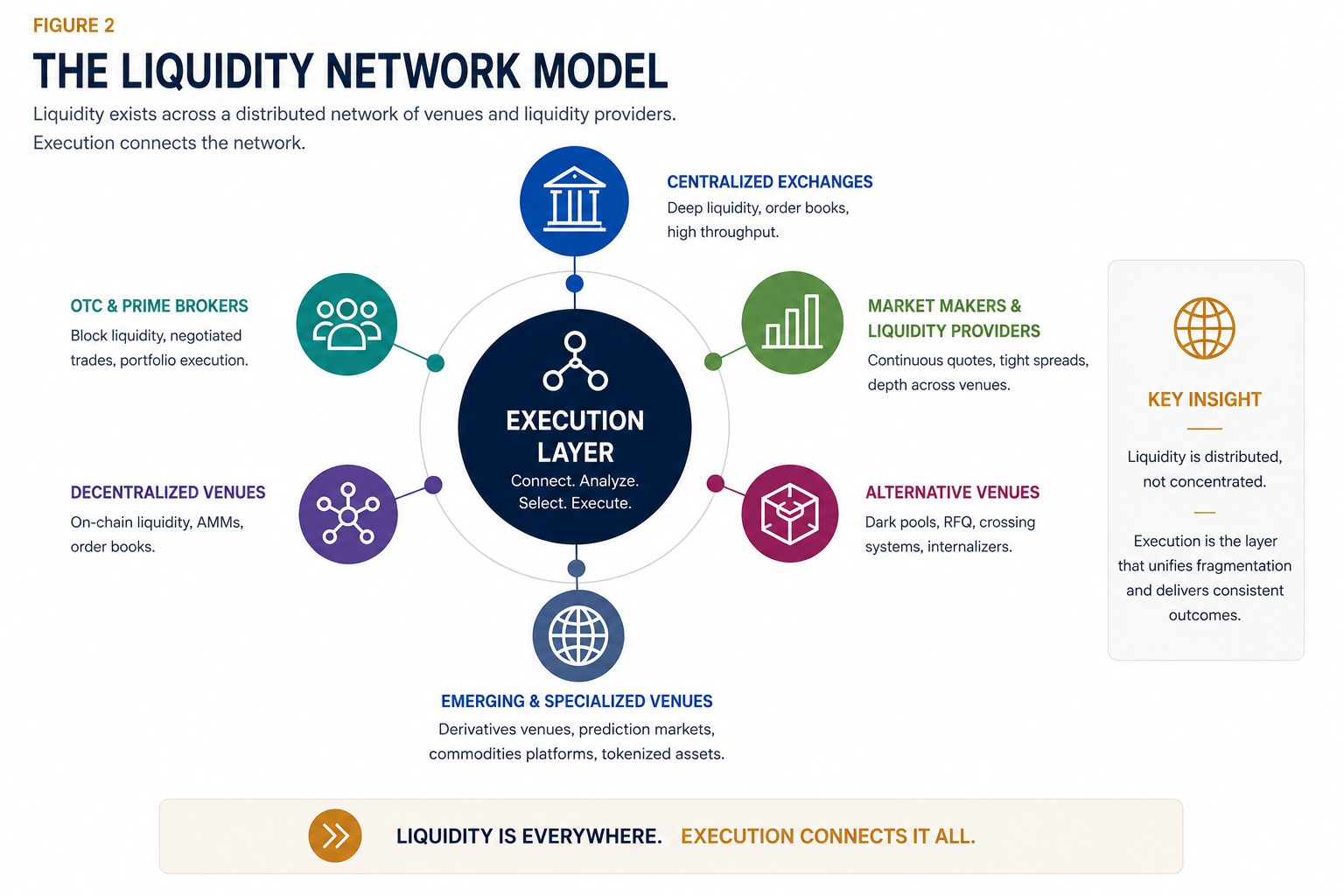
Modern market participants rarely interact with a single source of liquidity.
Instead, execution increasingly spans multiple centralized exchanges, decentralized venues, OTC counterparties, market makers and alternative execution mechanisms.
Each venue introduces its own APIs, authentication methods, rate limits, order semantics, market data structures and operational procedures.
Individually these differences appear manageable.
Collectively they create significant operational complexity.
Adding another venue is rarely a linear exercise. Every new integration expands monitoring requirements, testing procedures, deployment considerations and potential failure scenarios.
Technology teams increasingly spend their time maintaining infrastructure rather than improving execution.
Infrastructure should enable strategy.
It should not become the strategy.
Operational Complexity Is Becoming the Hidden Cost
As organizations expand across additional venues, products and jurisdictions, operational complexity often grows faster than trading activity itself.
Every additional integration introduces software maintenance, authentication management, connectivity monitoring, deployment cycles, infrastructure upgrades and operational risk.
These costs frequently remain underestimated because they are distributed across technology, operations and support functions rather than appearing as direct trading expenses.
Over time, however, operational complexity becomes one of the defining constraints on scalability.
Organizations that successfully abstract this complexity gain advantages extending well beyond execution quality.
They become more resilient. More adaptable. More efficient.
The New Competitive Advantage
Throughout the history of financial markets, competitive advantage has continually evolved.
It shifted from physical proximity to electronic connectivity.
From manual trading to algorithmic execution.
From isolated systems to globally connected infrastructure.
Today, another transition is underway.
Competitive advantage increasingly derives from operational excellence.
From resilient infrastructure.
From intelligent automation.
From execution quality.
From the ability to coordinate increasingly complex digital ecosystems efficiently and continuously.
Execution is no longer simply the outcome of trading.
Execution is becoming one of the defining capabilities of modern digital capital markets.
Conclusion
Capital markets will continue to evolve.
New asset classes will emerge.
New trading venues will be launched.
New technologies will reshape financial infrastructure.
Yet beneath each new wave of innovation, the same principle rmains true.
Markets function because infrastructure functions.
As financial systems become increasingly digital, continuously connected and operationally complex, execution is evolving from an operational activity into strategic infrastructure.
Organizations that recognize this transformation and invest accordingly will be better positioned to navigate the next generation of digital capital markets.